
Meet the Standard: ISO9001-Certified Atmospheric Furnace Parameters You Should Check Before Buying
Meet the Standard: ISO9001-Certified Atmospheric Furnace Parameters You Should Check Before Buying
Buying an industrial atmospheric furnace is rarely just about price. The more demanding the application—automotive gears, military components, bearing races, or commercial heat treatment—the more the specification sheet and the quality system behind it matter. This article explains what an ISO9001 certification does and does not tell you, which atmospheric furnace parameters deserve scrutiny, and how a buyer can verify a supplier instead of relying on marketing claims.
What Does "ISO9001-Certified Atmospheric Furnace" Mean in Practice?
ISO9001 is a quality management system (QMS) standard, not a product performance standard. When a manufacturer says its atmospheric furnace is ISO9001 certified, it means the organization has implemented a documented quality system covering design, production, inspection, and continuous improvement. The certificate is issued to the company or its manufacturing scope—not welded onto the furnace itself. That distinction matters: ISO9001 gives buyers reasonable confidence in process consistency, but it does not guarantee a specific hardening depth, atmosphere uniformity, or energy consumption.
For an industrial atmospheric furnace supplier, a valid ISO9001 certificate is therefore a baseline, not a substitute for reviewing technical parameters, configuration options, and the manufacturer's actual production experience.
How to Verify an ISO9001 Certificate
A certificate is only useful if it is authentic, current, and in the correct company name. Buyers can run a straightforward verification process before entering commercial negotiations.
Check the certificate number and issuing body
Every ISO9001 certificate has a unique number and an accredited certification body. For example, NORSEN's multi-purpose atmosphere furnace series (models RTQ, TQ, SHQ, DHQ) is covered under certificate number ISC-Q-2024-4373-R. The certificate was issued by Beijing National Standard Joint Certification Co., Ltd., and remains valid until 2027-08-29. The certified scope is "Technology Development and Manufacture of Heat Treated Industrial Electric Furnishings," under the standard GB/T19001-2016/ISO9001:2015, with global market applicability.
Buyers can confirm three things: whether the company name on the certificate matches the supplier's legal name; whether the standard is ISO9001:2015 (the current international edition); and whether the certificate expiry date has not passed.
Match the certificate scope to the product category
A certificate may exist but not cover furnace manufacturing. In NORSEN's case, the certified scope explicitly includes the technology development and manufacture of heat-treated industrial electric furnishing equipment, which covers the RTQ, TQ, SHQ, and DHQ atmosphere furnace series. If a supplier's certificate covers only trading or unrelated activities, that is not evidence of product quality.
- Legal company name exactly matches the contract entity.
- Certificate number can be confirmed with the issuing body.
- Standard is ISO9001:2015 (or national equivalent).
- Certification scope covers furnace or heat treatment equipment manufacturing.
- Expiry date is still valid.
Atmospheric Furnace Parameters Buyers Should Evaluate
Once the ISO9001 baseline is confirmed, the next step is a parameter-by-parameter review. For sealed box-type multi-purpose atmosphere furnaces—the type commonly used for carburizing, carbonitriding, oil quenching, and tempering—these are the parameters that directly affect output quality and production stability.
Furnace structure and material
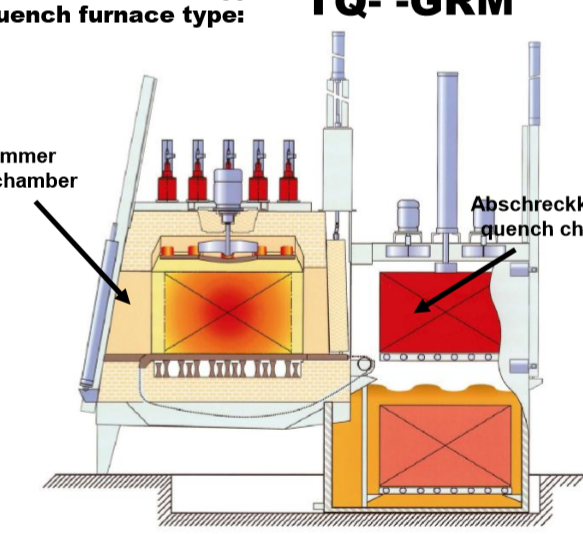
NORSEN's RTQ, TQ, SHQ, and DHQ models use a SiC muffle furnace structure with chain dual drive. The material specification is Q235 structural steel with stainless steel grades SS304 and SS310 used in critical high-temperature zones. The combination of silicon carbide muffle, stainless steel internals, and dual-drive chain mechanism is directly relevant to atmosphere uniformity, heat retention, and service life under repeated thermal cycling.
Atmosphere control system
The single most important parameter for carburizing and carbonitriding is how precisely the furnace controls carbon potential. A furnace equipped with an intelligent atmosphere control system, paired with high-performance heating elements, is better able to maintain stable carbon content across the load. In NORSEN's case, users report precise carbon content control as a measurable operating result.
Quenching system
For oil quenching, circulation and temperature uniformity inside the quench tank decide hardness consistency. NORSEN uses four symmetrical oil tank agitator motors. Symmetrically arranged agitation reduces the chance of uneven cooling, which matters for gear processing and bearing components that need uniform hardness and minimized distortion.
Safety and protection
A commercial heat treatment furnace runs on gas, electricity, and compressed air, so protection systems are non-negotiable. Look for over-temperature protection, over-current protection, and gas heating safety mechanisms.
Process capability
Multi-purpose atmospheric furnaces are expected to support more than one process. The NORSEN series supports hardening with oil quench, carbonitriding, tempering, and carburizing with case hardening. If your production plan includes multiple processes, the equipment should allow that flexibility without major reconfiguration.
Step-by-Step: How to Compare Certified Atmospheric Furnace Suppliers
- Define the metallurgical requirement. List the parts to be processed, target case depth, hardness range, and monthly volume. This determines the furnace type, usable dimensions, and automation level.
- Verify the quality management system. Ask for the ISO9001 certificate and check its scope, number, issuing body, and validity.
- Review the construction specification. Evaluate furnace structure, refractory materials, heating elements, quench system, atmosphere control, and safety components.
- Confirm the atmosphere control approach. The supplier should explain how carbon potential is measured and regulated for carburizing and carbonitriding.
- Check manufacturing capability and lead time. Ask about monthly capacity, custom configuration options, and pre-shipment testing. NORSEN, for example, produces 3–5 sets per month, works on an ODM basis, and performs a 100% pre-shipment test.
- Request the compliance paperwork. Include the ISO9001 certificate, standard references, safety documentation, and the commercial invoice details.
- Plan installation conditions. An atmosphere furnace line requires electricity, compressed air, natural gas, cooking fume ducts, and a factory crane height above 6.5 meters—the higher the better.
Use Cases: Where an ISO9001-Certified Atmosphere Furnace Is Required
An ISO9001-certified atmosphere furnace is a practical requirement in several industries because those sectors already operate under strict quality systems.
Automotive OEM and tier suppliers
Automotive OEMs and tier suppliers commonly demand documented quality management from equipment vendors. The consistency promised by ISO9001 supports the traceability that automotive PPAP and IATF workflows expect.
Military industry units
Military specifications require part-level traceability and strict process control. A certified manufacturer with documented furnace testing procedures reduces qualification risk.
Gear manufacturers
Gear processing demands carburizing and case hardening with precise carbon content control. The NORSEN atmosphere furnace series (RTQ, TQ, SHQ, DHQ) is used in applications that include gear processing, where the combination of atmosphere accuracy and quenching uniformity directly affects tooth surface hardness and fatigue resistance.
Hardware tool factories and commercial heat treaters
Hardware tools and commercial heat treatment shops need versatile furnaces that switch between carburizing, carbonitriding, quenching, and tempering. Multi-purpose atmosphere furnaces are a fit when the product mix changes frequently.
Certified Atmospheric Furnace Supplier Comparison
| Comparison Factor | NORSEN Atmospheric Furnace (RTQ/TQ/SHQ/DHQ) | Typical Global Brands (e.g., Ipsen) | What to Check |
|---|---|---|---|
| ISO9001 certification | Yes — ISC-Q-2024-4373-R, GB/T19001-2016/ISO9001:2015, valid to 2027-08-29 | Typically certified; verify local certificate number | Certificate scope and validity |
| Furnace structure | SiC muffle structure, chain dual drive | Various; often sealed box or pusher types | Match structure to required processes |
| Atmosphere control | Intelligent atmosphere control system | Brand-specific control platforms | Carbon potential accuracy and sensor type |
| Standard materials | Q235 / SS304 / SS310 | Often proprietary or localized materials | High-temperature alloy vs. economic choice |
| Processes supported | Oil quench hardening, carbonitriding, tempering, carburizing & case hardening | Broad process portfolio by model | Match to metallurgical requirements |
| Manufacturing location | Peixian County, Jiangsu, China; 6,000 m² factory | Germany, USA, or global plants | Logistics, installation, service accessibility |
| ODM / customization | Yes — effective size, automation, performance | Often limited or premium-cost | Project-specific configurations |
| Pre-shipment testing | 100% pre-shipment test | Typically factory acceptance test (FAT) | Agree test protocol in advance |
This comparison uses NORSEN's published specifications and publicly known positioning of global brands such as Ipsen. Buyers should request detailed quotation documents from each shortlisted manufacturer and verify specifications against their own process requirements.
Long-Term Value and Support Considerations
An ISO9001 certificate is a starting point; long-term value comes from installation quality, training, spare parts availability, and responsive service. NORSEN's after-sales package includes free remote technical assistance, and its export markets include Russia, Belarus, Southeast Asia, the Middle East, and Taiwan Province of China. The company's 55-employee team, 10-person R&D unit, and 6,000 m² facility reflect a manufacturing structure that supports custom projects and post-delivery support.
Case references from automotive OEMs, military industry units, hardware tool factories, and gear factories report stable quality, precise carbon content, high production efficiency, easy maintenance, and energy conservation. The stated 20-year operating history refers to the accumulated heat treatment equipment experience of the NORSEN team, which is relevant when evaluating design maturity and problem-solving ability.
Frequently Asked Questions
Is the NORSEN atmospheric furnace ISO9001 certified?
Yes. The multi-purpose furnace models RTQ, TQ, SHQ, and DHQ are covered under ISO9001 certification (GB/T19001-2016/ISO9001:2015), certificate number ISC-Q-2024-4373-R, issued by Beijing National Standard Joint Certification Co., Ltd. The certification scope covers the technology development and manufacture of heat-treated industrial electric furnishing equipment and is valid for the global market until 2027-08-29.
What processes can a NORSEN multi-purpose atmosphere furnace handle?
NORSEN's RTQ, TQ, SHQ, and DHQ series support hardening with oil quench, carbonitriding, tempering, and carburizing with case hardening. They use a SiC muffle furnace structure with chain dual drive, an intelligent atmosphere control system, high-performance heating elements, and four symmetrical oil tank agitator motors to support consistent process results.
Can NORSEN customize an atmosphere furnace for my factory?
Yes. NORSEN operates an ODM model and can customize the effective size of the equipment, the degree of automation, and equipment performance requirements. Monthly manufacturing capacity is 3–5 sets, with a lead time of approximately 150 days and a minimum order quantity of one unit.
Where can I request a quote or a sample specification?
For a project-specific quotation, buyers can contact NORSEN directly via email at jiayoubingsen@163.com or by phone at +86 153-8013-9999. The company also provides a downloadable brochure with its product lineup and company background. Requests are typically answered by the technical sales team covering China, Russia, Belarus, Southeast Asia, the Middle East, and other export markets.
Download the NORSEN brochure to review the full product scope and configuration options.
Download Company BrochureHave Questions or Need More Details?
Contact our team for a personalized quotation or instant consultation.
Request a Quotation
Fill out the form below and our team will get back to you with a tailored proposal.
WhatsApp Direct Chat
Prefer to chat in real-time? Message us on WhatsApp for instant assistance & quick answers.
- Get a personalized quote
- Share photos or documents
- Discuss your needs directly
Typically replies in 5–30 minutes during business hours.