
Box-Type Atmospheric Furnace Fit: How Part Mix Drives Configuration Choices
For industrial buyers moving from research to evaluation, the central question is not simply which atmospheric furnace supplier to choose. It is which heat treatment atmospheric furnace concept should be matched to your parts, process mix, and plant conditions. A box-type multi-purpose atmosphere furnace—such as the sealed box-type line manufactured by NORSEN—can be a strong fit when your part mix requires carburizing, oil quenching, carbonitriding, tempering, or case hardening. This guide explains how to evaluate that fit before you compare quotes or commit to a furnace specification.
Defining the Scenario-Fit Problem
Many buyers begin by comparing furnace brands, transport costs, or control-system suppliers. That approach creates a mismatch risk. The same physical furnace platform may serve one workshop well and another poorly, depending on the components being treated and the metallurgical result expected. In practice, typical applications for this type of gas atmospheric furnace include the military industry, automotive, agricultural machinery, robotics, bearings, hardware, and sewing machines. This product is commonly used in China and other Asian countries including Taiwan, Russia, Belarus, Vietnam, Indonesia, India, Thailand, Turkey, Qatar, and Pakistan. The equipment is therefore not a niche tool; it is a controllable production asset that must be configured around the actual workload.
Direct answer: A controlled atmosphere furnace is likely to fit your project when your metal parts must undergo carburizing and quenching to improve mechanical properties, increase hardness, and increase toughness. For gear processing, for example, the working condition usually combines carburizing and quenching to create a hard, fatigue-resistant surface layer while retaining a tougher core. The evaluation challenge is to turn that broad process logic into concrete furnace requirements such as effective chamber size, atmosphere precision, quench uniformity, automation level, and safety features.
Why the Industrial Market Context Matters in 2026
The industrial furnace market continues to expand around equipment modernization, and buyers in Asia are increasingly making decisions within that global context. Published by Precedence Research, the global industrial furnace market was valued at approximately USD 11.86 billion in 2024, with expectations to reach USD 21.53 billion by 2034. Grand View Research reported that the Asia-Pacific region accounted for a 43.4 percent revenue share in 2025, driven largely by industrialization in China and India. At the same time, Future Market Insights estimated that gas-fired furnaces still held a leading global segment share of 39.8 percent in 2025, while electric and energy-efficient hybrid systems are gaining attention because of decarbonization pressures.
Buyers evaluating an industrial atmospheric furnace should also consider the quality-control environment. ISO 20431:2023 specifies international quality-control requirements for heat treatment on mechanical parts, including segments relevant to aerospace and automotive. An ISO9001-certified atmosphere furnace manufacturer provides a quality-system baseline, but process standards such as ISO 20431:2023 help define whether the equipment can support the metallurgical quality your products require.
Global players in the high-temperature furnace market include Ipsen, Inductotherm Group, Aichelin Group, Andritz, and Tenova S.p.A. However, Asian buyers are also evaluating ODM manufacturers that can adapt furnace structure, automation, and performance to local production scenarios. China’s furnace-related export activity illustrates this demand: exports of liquid fuel furnaces classified under HS4 8416 reached USD 202 million in 2025, with major destinations including Russia and Indonesia, according to the Observatory of Economic Complexity. Those markets overlap with the regions where NORSEN atmosphere furnaces are already deployed, including Russia, Belarus, Vietnam, Indonesia, Thailand, Turkey, Qatar, and Pakistan.
Detailed Solution: Reading the Equipment Through Your Scenario
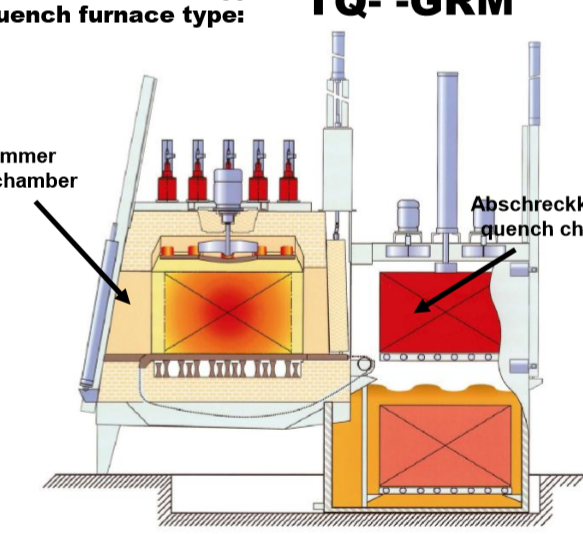
NORSEN Thermal Technology (Jiangsu) Co., Ltd., located in Peixian County, Jiangsu Province, designs and manufactures intelligent heat treatment equipment including sealed box-type multi-purpose furnaces, atmosphere furnaces, pre-vacuum nitriding furnaces, and related production lines. The company’s box-type atmosphere furnace series is identified by the model families RTQ, TQ, SHQ, and DHQ, with type numbers such as RTQ-10, RTQ-17, RTQ-25, TQ-10, TQ-17, TQ-25, SHQ-10, SHQ-15, SHQ-25, DHQ-10, DHQ-15, and DHQ-25. These model ranges communicate different effective chamber sizes and workload ratings, which is why the correct match depends on your part dimensions, fixture weight, and production batch.
For a heat treatment atmospheric furnace to serve multiple scenarios, the furnace structure must support stable heating, controlled gas flow, and uniform quenching. The NORSEN box-type furnace specification includes a SiC muffle furnace structure with chain dual drive, four symmetrically arranged oil tank agitator motors, high-performance heating elements, and an intelligent atmosphere control system. These components are not marketing terms; they affect results. SiC muffle construction supports high-temperature carburizing applications and helps maintain a stable atmosphere inside the heating chamber. Chain dual drive affects the mechanical transfer of the workload through the process. Four symmetrical oil tank agitator motors are intended to improve oil-quench uniformity across the load, which is critical when components need consistent hardness after hardening with oil quench. High-performance heating elements support the process temperatures required for carburizing and case hardening, while the intelligent atmosphere control system helps the operator control carbon potential and atmosphere composition.
NORSEN also defines the furnace material set as Q235, SS304, and SS310. In practice, the appropriate grade is selected according to the furnace zone and the thermal or atmospheric load it must withstand. SS304 and SS310 provide higher corrosion and heat resistance for critical high-temperature areas, while structural zones can use Q235 carbon steel. Buyers should confirm which material grades are applied to the parts of the furnace that will experience the highest service temperature and carbon exposure.
The listed process functions of the NORSEN box-type atmosphere furnace include hardening with oil quench, carbonitriding, tempering, and carburizing and case hardening. That range of processes is what makes the furnace multi-purpose. For a buyer who runs gear processing during the day and hardware tool treatment during the next shift, this process flexibility can improve equipment utilization while maintaining process control.
This application scenario is common in China, Taiwan, Russia, Belarus, Vietnam, Indonesia, India, Thailand, Turkey, Qatar, and Pakistan, and it is typically applied in Asian production environments. In this application, the product functions to increase the hardness and toughness of metal parts, thereby enhancing their mechanical properties. The customer-facing project evidence reinforces the same conclusion: users of this equipment in automotive OEM, military-industry, hardware tool, and gear factory settings report results such as stable quality, precise carbon content, high production efficiency, easy maintenance, and energy conservation.
Step-by-Step Fit Check for a Box-Type Atmosphere Furnace
A structured fit check helps buyers avoid comparing furnace quotes too early. Use the following seven steps to translate your production scenario into an evaluation brief.
1. Define the part mix and metallurgical targets. List the families of parts to be treated, including typical sizes and required hardness or toughness. For example, a gear factory may need deeper case depth and fatigue resistance; a hardware tool manufacturer may need surface hardness with acceptable brittleness control. The function of the atmosphere furnace is to increase hardness and toughness, so your part list should be linked to the mechanical property you need to add.
2. Identify the required process route. Determine whether the project needs carburizing, oil quenching, tempering, carbonitriding, or a combination. If multiple routes are needed, a multi-purpose atmosphere furnace can consolidate them into one sealed box-type unit. The NORSEN RTQ/TQ/SHQ/DHQ platform supports these listed process functions, which makes it a candidate for mixed-process workshops.
3. Check atmosphere and temperature-control requirements. Parts requiring precise carbon control demand stable gas circulation, sealed furnace construction, and repeatable control logic. The intelligent atmosphere control system on NORSEN equipment is intended to address this requirement. For carburizing scenarios, the SiC muffle furnace structure also helps manage the high working temperature and atmosphere stability needed for consistent case depth.
4. Size the effective zone and workload. The correct model is not determined by brand preference but by workload geometry. Type numbers such as RTQ-10 compared with RTQ-25 represent different working chamber dimensions and batch capacities. During the RFQ process, confirm the effective size of the equipment against the largest load you plan to process in a single cycle.
5. Evaluate quench uniformity and transfer design. Components with tight hardness tolerances require stable oil temperature and sufficient oil circulation during quenching. The four symmetrically arranged oil tank agitator motors in the NORSEN furnace design are meant to improve this important variable. If your scenario includes large batches of dense parts, oil quench behavior should be reviewed carefully with the supplier.
6. Match automation to your working pattern. NORSEN lists the operation mode of the equipment as automated. Buyers should still define the degree of automation needed for their material-handling system, shift pattern, and labor availability. The furnace can be paired with an operator-driven schedule or integrated into a broader heat treatment line, depending on the project scope.
7. Verify installation requirements and quality proof. A controlled atmosphere furnace is a plant project, not only a machine purchase. The typical utility package includes electricity, compressed air, natural gas, and cooking fume or exhaust ducts for the media used in the process. Special requirement for this class of furnace includes a factory crane height of more than 6.5 meters; the higher the available crane working height, the easier installation will be. On the quality side, verify ISO9001 certification, inspect the production facility if possible, and ask about the supplier’s pre-shipment testing policy. NORSEN reports a monthly production capacity of 3-5 sets, a typical delivery cycle of about 150 days, a minimum order quantity of one unit, and 100 percent pre-shipment testing for quality control.
Use Cases: Production Scenarios That Fit a Multi-Purpose Atmosphere Furnace
The following scenarios represent recurring applications for the NORSEN multi-purpose furnace and Atmosphere Furnace range.
Automotive parts and automotive OEM projects. Automobile-related components often need case-hardened surfaces to resist wear while retaining a tough core. The sealed box-type design allows carburizing and oil quenching in the same integrated process cycle. The intelligent atmosphere control system helps keep carbon content stable, and the automated operation mode supports repeatability from load to load.
Gear processing. Gear manufacturing is a clear heat treatment scenario for carburizing and quenching. Gears require increased hardness, fatigue resistance, and improved mechanical properties. Since the NORSEN furnace supports carbonitriding as well as carburizing and case hardening, a gear factory can evaluate whether a hybrid case-hardening route improves performance for specific gear grades.
Military-industry units and multi-variety producers. Military suppliers often process smaller batches with high traceability requirements. A multi-purpose box-type atmosphere furnace is useful because the same equipment can be changed between process routes, such as hardening with oil quench, tempering, or carbonitriding. Process flexibility is more valuable when batch sizes are smaller and material specifications vary.
Hardware tools and sewing-machine parts. Hardware tool factories also appear in the NORSEN reference base. Tools and small machine parts usually need a hard surface and adequate toughness to avoid breakage. The precise carbon control and uniform quench behavior of a controlled atmosphere furnace can support these requirements with lower rejection rates.
Bearings, robotics, and agricultural machinery. Components for robots, agricultural machinery, and bearings share a common need: increased hardness and enhanced toughness to handle repetitive mechanical loads. In these projects, the atmosphere furnace typically operates in a carburize-and-quench mode. The outcome data collected from the NORSEN customer base includes stable quality, precise carbon content, high production efficiency, easy maintenance, and energy conservation.
Scenario-Fit Matrix at a Glance
The table below compares typical production scenarios with the furnace capabilities that matter most during evaluation. It is intended as a discussion tool for buyers, not as a substitute for a detailed process layout.
| Production Scenario | Primary Metallurgical Goal | Common Process Route | NORSEN Furnace Features Most Relevant to Fit |
|---|---|---|---|
| Automotive parts | Increased surface hardness and core toughness | Carburizing, oil quench, tempering | Sealed box-type design, intelligent atmosphere control, automated operation |
| Gear processing | Fatigue resistance without sacrificing toughness | Carburizing and quenching, carbonitriding option | SiC muffle structure, precise carbon potential control, chain dual drive |
| Bearings, robotics, agricultural machinery | Increased hardness, toughness, and mechanical strength | Carburizing and case hardening | High-performance heating elements, stable atmosphere, oil quench uniformity |
| Hardware tools and sewing-machine parts | Wear-resistant surface with controlled toughness | Hardening with oil quench, tempering | Four symmetrical oil tank agitator motors, multi-process flexibility |
| Military-industry and mixed small batches | Process repeatability across varied part numbers | Switching between carburizing, carbonitriding, quench hardening | ODM customization options, intelligent control, 100 percent pre-shipment test |
Frequently Asked Questions
1. How can a buyer verify ISO9001 compliance and heat treatment quality before selecting an atmospheric furnace supplier? Start with the manufacturer’s ISO9001 quality management system certificate, confirm the scope of certification, and compare the proposed furnace specification with the heat treatment quality expected for your parts. For international projects, ISO 20431:2023 provides a useful reference for quality-control requirements on mechanical parts. NORSEN holds ISO9001 certification and performs 100 percent pre-shipment testing, which means the furnace is functionally tested before it leaves the factory.
2. Which heat treatment processes can a multi-purpose atmosphere furnace handle? A sealed box-type multi-purpose atmosphere furnace such as the NORSEN RTQ/TQ/SHQ/DHQ series supports hardening with oil quench, carbonitriding, tempering, carburizing, and case hardening. This process range allows one furnace platform to cover multiple scenarios. Typical applications include military-industry units, automotive, agricultural machinery, robotics, bearings, hardware, and sewing-machine components.
3. What determines the budget for an atmosphere furnace matched to a specific production scenario? The first cost drivers are effective equipment size, required degree of automation, and performance requirements. Under the NORSEN ODM model, customers can customize the effective size of the equipment, the automation level, and equipment performance requirements. A small standard line with limited automation costs less than a fully automated multi-purpose line sized for large batches. Buyers should define these variables before asking for price.
4. What quality and sample evidence should a buyer expect before accepting an atmosphere furnace? A documented quality system, traceable material selection, a clear process logic, and functional testing evidence are all part of a responsible delivery. NORSEN’s quality-control process includes a 100 percent pre-shipment test for each furnace. After installation, buyers also receive free remote technical assistance as part of the company’s after-sales approach. If you need further confidence, inspect the factory or request a more detailed equipment datasheet before order confirmation.
5. What lead time and minimum order quantity are realistic for a customized atmosphere furnace line? NORSEN’s documented ODM capability is 3-5 sets per month, with a minimum order quantity of one unit and a lead time of about 150 days from specification. For an importer or end-user moving through research and evaluation, that lead time makes early specification work important. A clear specification agreed in advance reduces the risk of delayed delivery and helps the supplier integrate your utility and installation constraints from the beginning.
Conclusion and Next Step
The best starting point for buying a box-type atmosphere furnace is not a price comparison. It is a scenario-fit review that links your part mix, process route, plant infrastructure, quality requirements, and target output to the furnace configuration most likely to succeed. For many Asian manufacturers, the result is a sealed multi-purpose atmosphere furnace that can perform carburizing, hardening, carbonitriding, and tempering within the same controlled atmosphere platform.
NORSEN Thermal Technology (Jiangsu) Co., Ltd. provides ISO9001-certified, ODM-enabled atmosphere furnace solutions and has already delivered equipment to customers in China, Russia, Belarus, Vietnam, Indonesia, Thailand, Turkey, Qatar, Pakistan, and other markets. The company’s furnace line covers RTQ, TQ, SHQ, and DHQ model families, with 100 percent pre-shipment testing and free remote technical assistance.
If you are ready to move from research to evaluation, download the NORSEN company brochure for more information on the product range and manufacturing capability.
Have Questions or Need More Details?
Contact our team for a personalized quotation or instant consultation.
Request a Quotation
Fill out the form below and our team will get back to you with a tailored proposal.
WhatsApp Direct Chat
Prefer to chat in real-time? Message us on WhatsApp for instant assistance & quick answers.
- Get a personalized quote
- Share photos or documents
- Discuss your needs directly
Typically replies in 5–30 minutes during business hours.