
Heat Treatment Furnace Compliance: ISO9001 Is Only Step One
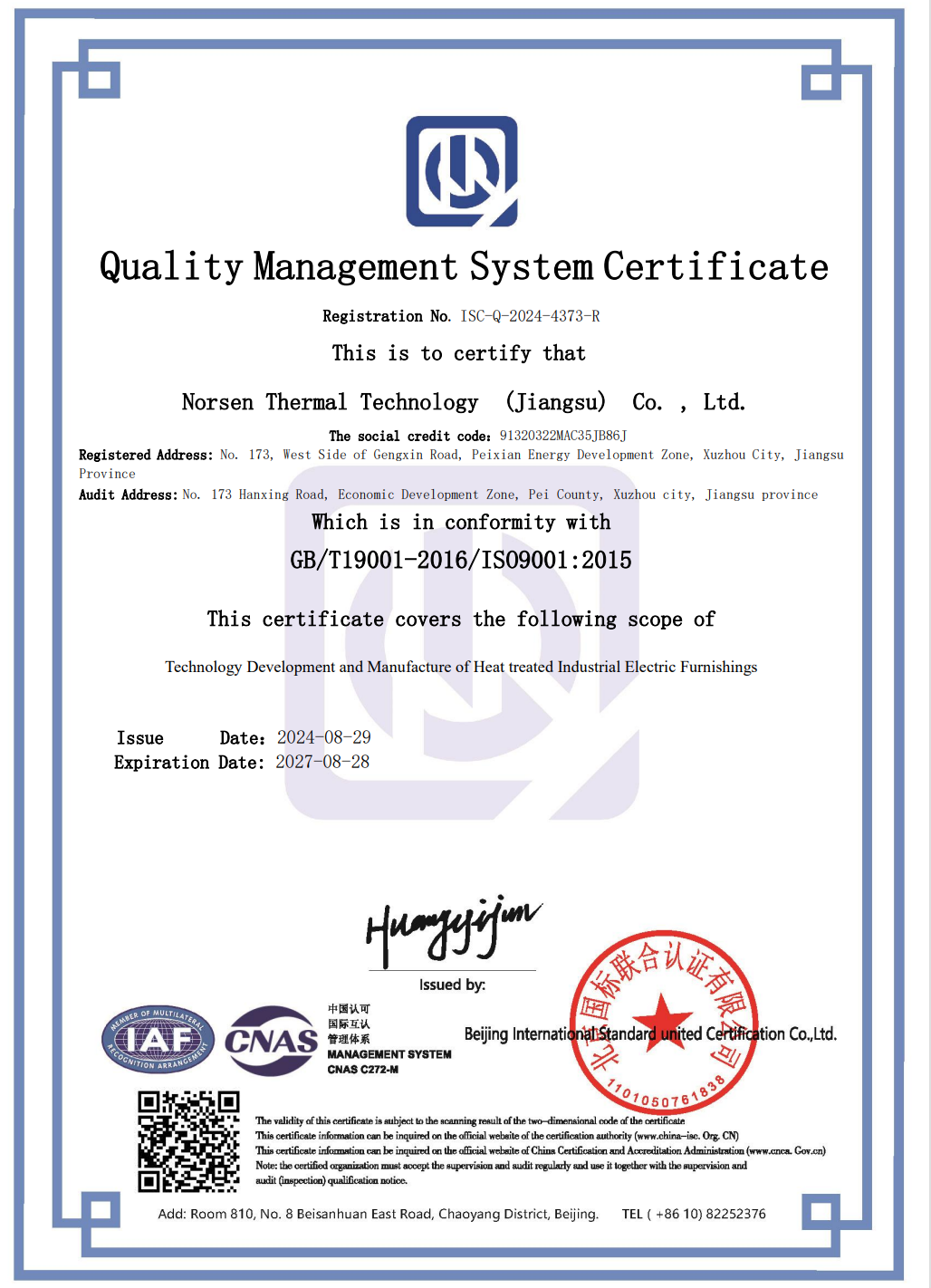
NORSEN ISO9001 certificate ISC-Q-2024-4373-R, issued 29 August 2024 and valid to 29 August 2027.
An ISO9001 certificate answers one narrow question: has a manufacturer's quality management system been independently assessed against a recognised standard? It does not answer the question a furnace buyer usually needs answered — whether a specific machine, delivered to a specific country and installed on a specific shop floor, will satisfy that market's import rules, that plant's utility conditions and that customer's process qualification.
For Norsen Thermal Technology (Jiangsu) Co., Ltd., a heat treatment equipment manufacturer based in Peixian County, Jiangsu Province, the certificate is a starting document, not the whole compliance file. Treated that way, it becomes genuinely useful: it fixes the supplier's system scope, dates and certification body, and it gives the buyer a fixed reference point from which to organise everything else — market-entry checks, pre-shipment testing, factory pre-acceptance and on-site final acceptance.
This guide does three things. It states exactly what the NORSEN ISO9001 certificate covers. It separates that certificate from the country-by-country checks that only your own compliance owner, customs broker and customer can confirm. And it shows how to turn the company's documented quality gates into one acceptance record you can sign, file and defend in an audit.
What the NORSEN ISO9001 certificate actually states
The certificate is specific, and every field matters when a buyer files it.
- Certification number: ISC-Q-2024-4373-R
- Issuing body: Beijing National Standard Joint Certification Co., Ltd.
- Standard: GB/T19001-2016 / ISO9001:2015
- Scope: Technology Development and Manufacture of Heat Treated Industrial Electric Furnishings
- Issue date: 29 August 2024 | Expiry date: 29 August 2027
- Declared market coverage: Global
- Linked product line: the multi-purpose furnace / atmosphere furnace series (models RTQ, TQ, SHQ, DHQ)
Two practical readings follow. First, the scope is a system scope — technology development and manufacture — not a type approval of any individual furnace. Second, the certificate has a fixed expiry date. If your purchase order, lead time and site acceptance extend past 29 August 2027, record the re-certification status as a condition of the order rather than assuming continuity.
What the certificate does not do
ISO9001 does not certify that a furnace meets a named national electrical or gas-safety regulation, and it is not an import authorisation for any country. It also does not replace customer-specific qualification. Where a buyer's own customer invokes furnace qualification standards, those sit alongside — not inside — the ISO certificate.
The relevant standard families are well documented. ISO/TC 244 covers industrial furnaces and associated processing equipment, including quality requirements and recommendations applicable to heat treatment of mechanical parts used in car manufacturing, aerospace, pipeline systems, civil engineering equipment, earth moving machinery, agricultural equipment, the naval industry, energy equipment, tooling and fasteners. ASTM A991/A991M sets out procedures for conducting a temperature uniformity survey on a furnace used to heat treat steel products. AMS 2750 and CQI-9 are described by SAT Thermique as subjecting heat treatment processes to stricter rules covering temperature uniformity, instrumentation, calibration and system accuracy testing. Exact procedures differ between these documents, so confirm clause-level requirements against the standard text and your customer's specification before you write them into a purchase contract.
Build the compliance file before you compare quotations
A furnace quotation is easy to compare on price and hard to compare on evidence. Splitting the file into four sections fixes that, because each section answers a different question and each has a different owner on your side.
| File section | What to request | What it evidences | What it does not evidence |
|---|---|---|---|
| 1. Supplier system | ISO9001 certificate with number, scope, issue and expiry dates; certification body name | An independently assessed quality management system within a stated scope | Product performance of a particular unit, or market entry clearance |
| 2. Product and process | Model and type designation, configuration list, utility requirements, safety devices, process cycles | Whether the machine as configured matches your part, process and building | That the unit has already passed your acceptance test |
| 3. Market entry | Whatever your importing authority, port, utility provider and customer require | Legal permission to import and operate in your jurisdiction | Anything about the supplier's quality system |
| 4. Transaction | Quotation with Incoterm and named place, payment schedule, packing list, test and acceptance certificates | Who pays for what, who carries risk when, and what was proven before shipment | That the machine will perform on your parts at your site |
Section 3 is the one buyers most often outsource to the supplier by accident. It is yours. A supplier can support it with documents, but the determination belongs to your market's authorities and your customer's specification.
Regional market checks across NORSEN's declared markets
NORSEN's stated main markets are China, Russia, Belarus, Vietnam, Indonesia, Thailand, Turkey, Qatar and Pakistan. Export business accounts for 40% of total sales. The company's case record also lists users in India and Taiwan alongside those markets, with a combined quantity of ten units across automotive OEM, military, hardware-tool and gear-factory customers. That record is a supplier-side reference, not independent verification of any installed result, and it shows where equipment has been sold — not that your particular market approval is already satisfied.
The table below deliberately records checks to confirm, not conclusions. This article does not state the legal requirements of any country, because those are set by that country's authorities and can change between order and installation.
| Market | Checks to confirm with your broker, authority and customer before signing |
|---|---|
| China | Domestic installation acceptance route, utility connection approvals, and whether your end customer requires incoming inspection records at their gate. |
| Russia | Import documentation set, consignee and customs requirements, and the language expected for nameplates, manuals and operator documentation. |
| Belarus | Route of entry and transit documentation, plus the same language and operating-document checks as Russia. |
| Vietnam | Port handling, electrical supply characteristics at site, exhaust and ventilation arrangements, and factory-level safety acceptance before commissioning. |
| Indonesia | Import licence route and site utility supply, including whether gas supply is available and at what condition for gas heating configurations. |
| Thailand | Import clearance documentation and whether your customer requires witnessed factory acceptance as a condition of payment. |
| Turkey | Customs union documentation, operating-document language, and site conditions that may affect quench tank handling and overhead clearance. |
| Qatar | Import routing and port clearance, plus ambient conditions and cooling arrangements that may differ sharply from Chinese factory conditions. |
| Pakistan | Import documentation and inland transport constraints, including crane capacity on arrival and the route to your installation bay. |
One realistic pattern: buyers tend to spend weeks on the machine specification and a single afternoon on market entry. Reverse that weight. The machine can be modified by change order; an import that is refused at the port cannot be.
Three acceptance gates, one record
NORSEN's manufacturing capability data states 100% pre-shipment testing. That statement is most useful when it is tied to two further gates the buyer controls: factory pre-acceptance before packing, and on-site final acceptance before the last payment milestone. Together they form a chain in which each gate closes a different risk.
| Gate | When | Record items | Who signs |
|---|---|---|---|
| 1. Pre-shipment test | Before packing, on 100% of units | Test items performed, readings, configuration verified against the order, safety device function | Supplier quality function; countersigned by buyer if witnessed |
| 2. Factory pre-acceptance | Before crating, with your team present | Agreed process cycle, atmosphere control response, agitator and drive checks, deviation list | Buyer and supplier, jointly |
| 3. On-site final acceptance | After installation and commissioning | Site utility readings, repeat of agreed checks, first production results, open-items closure | Buyer, supplier and, where used, a third-party inspector |
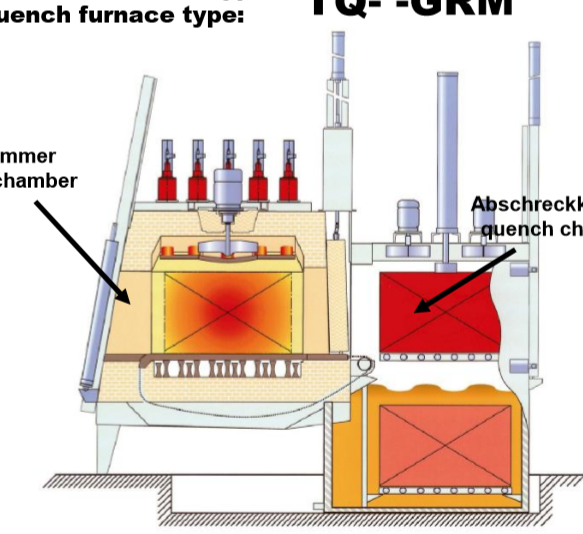
The multi-purpose atmosphere furnace line covered by the ISO9001 record (models RTQ, TQ, SHQ, DHQ).
Step-by-step: writing an acceptance record you can defend
The sequence below keeps each gate auditable and prevents the common failure where acceptance is signed on a verbal understanding.
Step 1 — Freeze the configuration in writing
Record the exact type designation from the RTQ, TQ, SHQ or DHQ series, plus the three customization dimensions NORSEN lists: effective equipment size, degree of automation, and performance requirements. Everything downstream is measured against this document, so an unclear configuration statement silently invalidates later test results.
Step 2 — Survey the site against the application data
The application record for carburizing and quenching of metal parts states a factory crane height above 6.5 metres, adding that higher is better. It also lists matched equipment as electricity, compressed air, natural gas, and ducting with its associated media. Confirm both against your actual bay, and confirm the exact utility list against the data sheet for your specific model.
Step 3 — Agree the test plan before the pre-shipment test
Write down which checks constitute a pass, at what operating point, and who records the numbers. A 100% pre-shipment test only protects you if you know in advance what was measured.
Step 4 — Witness factory pre-acceptance on a real cycle
The multi-purpose furnace's documented processes are hardening with oil quench, carburizing and case hardening, carbonitriding, and tempering. Run the cycle closest to your own part family and record what happened. The furnace structure — SiC muffle with chain dual drive — and the four symmetrical oil tank agitator motors are verifiable physical items: count them, check they operate, and note it.
Step 5 — Capture control and safety data
The intelligent atmosphere control system and the high-performance heating elements should appear in the record with observed responses, not just a description. Over-temperature protection and over-current protection should be tested and the test result logged; where a gas heating configuration is supplied, its supply conditions belong in the same section.
Step 6 — Close the packing and shipping record
Compare the packing list against the frozen configuration item by item. Photograph the packed unit and the loading. NORSEN's stated lead time is 150 days and monthly capacity is 3–5 sets, with a minimum order quantity of one unit — so a slip here is expensive to recover.
Step 7 — Repeat the agreed checks on site
Site acceptance is where utility reality replaces factory reality. Log actual voltage, compressed air pressure, gas supply condition and duct performance, then repeat the process checks agreed at Step 3. Where your customer requires temperature uniformity or instrumentation evidence, this is the point at which the measurement method must already be agreed.
Step 8 — Close out and hand over the document set
Signed gates, open-items list with closure dates, spare parts list, drawings and manuals as agreed, and the after-sales arrangement. NORSEN's stated after-sales support is free remote technical assistance; write into the record how that channel is accessed and who on your side owns it.
Site requirements that belong in the record, not in an email
The 6.5 metre crane height is the item most often lost between quotation and installation. It matters because charge and quench handling, and maintenance access to the furnace top, depend on overhead clearance — and because once the machine is on site, a building that is too low cannot be fixed by the supplier. Put the measured clearance in the record with the date and the person who measured it, alongside a note that the stated minimum is 6.5 metres and higher is preferred.
Utilities belong in the same section for the same reason. Electricity, compressed air, natural gas and ducting with its associated media are all supplied by you, not by the furnace. If a gas heating configuration is part of the order, the gas supply condition becomes a contractual dependency rather than a commissioning detail.
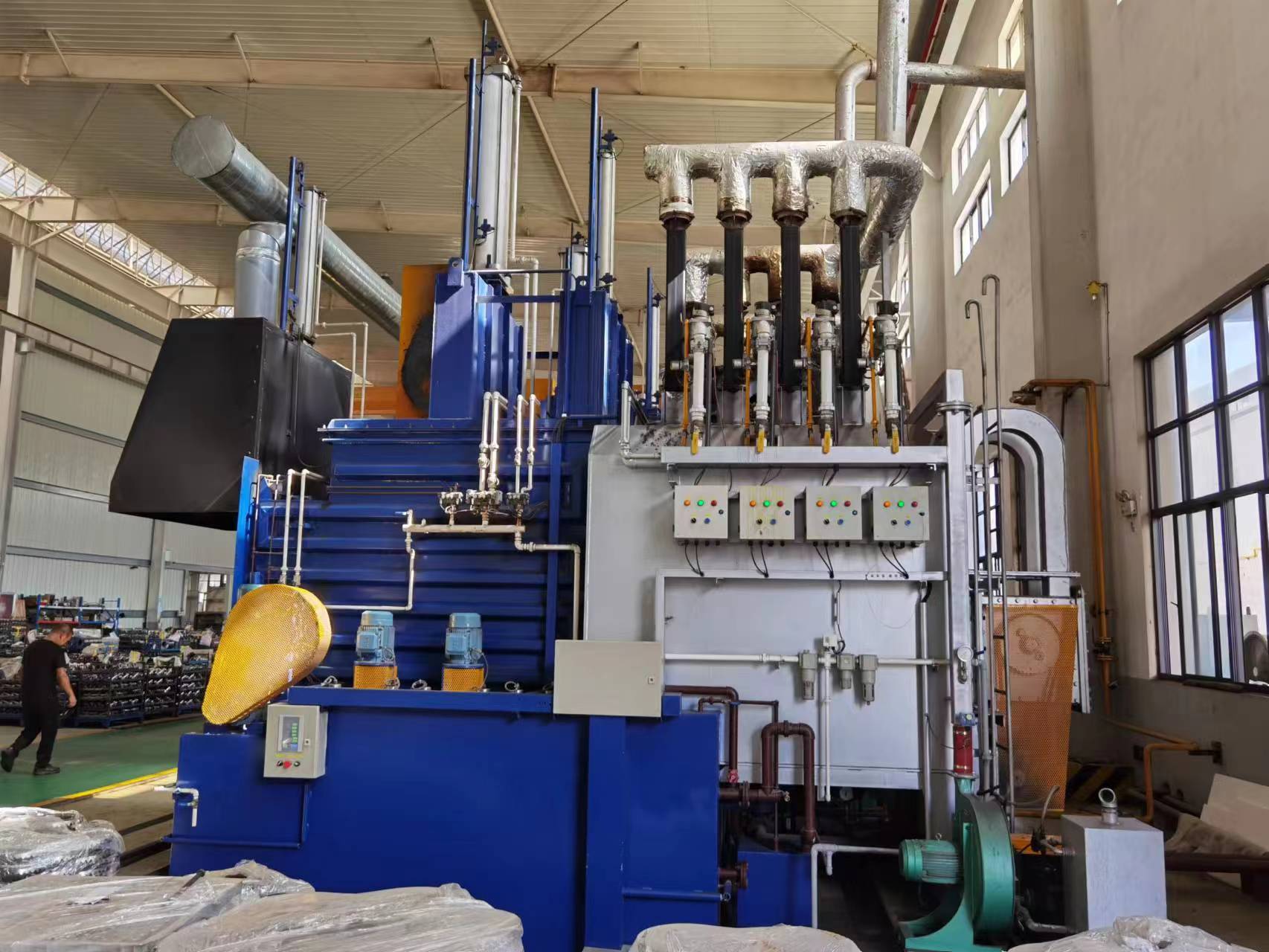
Furnace structure and drive arrangement: verifiable physical items for the pre-acceptance record.
Matching the product line to the process before you write the acceptance plan
Compliance documents describe a manufacturer; the acceptance record describes a machine. The bridge between them is the configuration. NORSEN's portfolio covers sealed box-type multi-purpose furnace production lines, pre-vacuum gas nitriding furnaces, mesh belt carburizing and quenching furnace production lines, well-type furnaces and other heat treatment equipment. Within the ISO record, the multi-purpose furnace line is the one explicitly linked to the certificate.
For that line, the supplied product data records a SiC muffle furnace structure with chain dual drive, four symmetrical oil tank agitator motors, high-performance heating elements, and an intelligent atmosphere control system, with over-temperature and over-current protection. Documented processes are hardening with oil quench, carbonitriding, tempering, and carburizing and case hardening. Construction materials are listed as Q235, SS304 and SS310, and target industries as military, automobiles, agricultural machinery, robots, bearings, hardware and sewing machines.
Two cautions keep this honest. First, not every configuration in a series shares identical features — confirm the list against your chosen model rather than reading the paragraph as a specification for all of them. Second, capability statements such as 6,000 m² of manufacturing space, approximately 55 staff, a 10-engineer R&D team and annual output of 50 sets tell you about continuity and change capacity; they do not tell you how your furnace will perform on your parts.
Documents to request alongside payment terms and delivery
Delivery terms are where compliance files most often fall apart, because the document set changes with the Incoterm. Ask for the term, the named place and the exclusions in writing. EXW leaves export clearance and main carriage with you; FOB places loading on board with the supplier and main carriage with you; CIF adds carriage and insurance to a named destination port, while risk still transfers at shipment. The supplied NORSEN records do not state which term applies to a given quotation, so confirm it per order rather than assuming from a previous one.
Ask for these alongside the commercial terms:
- Quotation stating Incoterm, named place, scope of supply and exclusions
- Payment schedule written against named milestones, so each instalment maps to a documented gate rather than to a date alone
- Commercial invoice and packing list matching the frozen configuration
- Transport document (bill of lading or air waybill) and, under CIF, the insurance certificate
- Certificate of origin or other import documents, where your broker confirms they are needed
- Pre-shipment test record and signed factory pre-acceptance report
- ISO9001 certificate copy with number, scope, issue and expiry dates
- Installation, operation and maintenance documentation in the language your operators and authority require
- Spare parts list and the remote technical assistance arrangement
Your bank and customs broker decide which of these your market actually requires. The supplier's job is to issue them accurately and consistently; the buyer's job is to state the list before the order, not after the vessel has sailed.
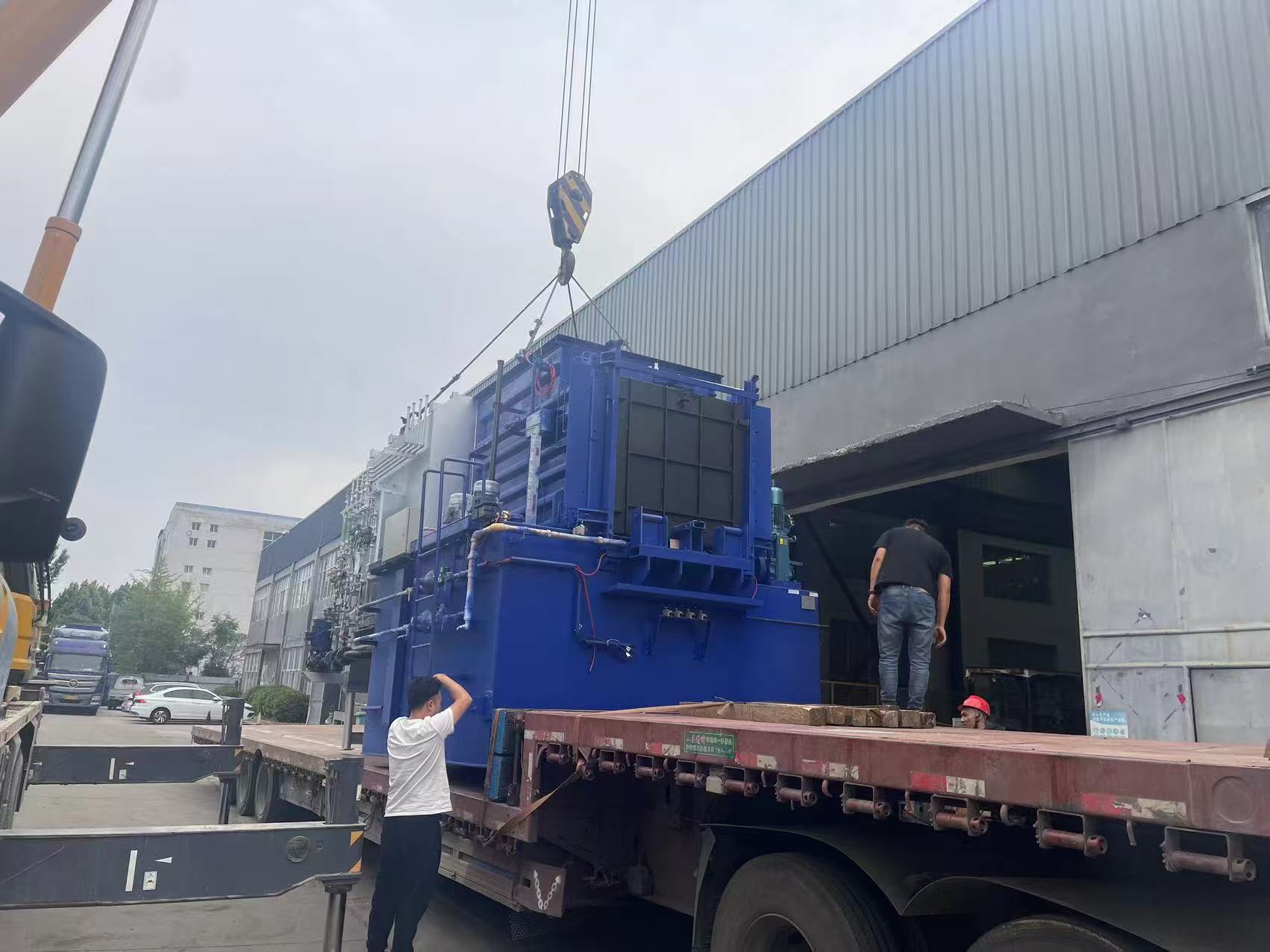
Packing and loading records complete the pre-shipment section of the compliance file.
Frequently asked questions
Does NORSEN's ISO9001 certificate clear my country's import requirements?
No. The certificate, number ISC-Q-2024-4373-R and issued by Beijing National Standard Joint Certification Co., Ltd., confirms an assessed quality management system under GB/T19001-2016/ISO9001:2015 for the scope of technology development and manufacture of heat treated industrial electric furnishings. Import permission, electrical and gas-safety acceptance, and any customer-specific qualification are determined by your market's authorities and your customer's specification. Treat the certificate as supplier-qualification evidence and confirm market entry separately.
What should a factory pre-acceptance record contain?
At minimum: the frozen configuration with type designation; the agreed test plan; the process cycle actually run, drawn from hardening with oil quench, carburizing and case hardening, carbonitriding or tempering; observed responses of the atmosphere control system; verification of the SiC muffle structure, chain dual drive and four oil tank agitator motors; function tests of over-temperature and over-current protection; a deviation list with owners and dates; and joint signatures. Anything not written down at this gate becomes a dispute at the next one.
What drives the budget of a multi-purpose atmosphere furnace?
This guide does not quote prices, but the cost drivers are identifiable from the supplied data: the type size within the RTQ, TQ, SHQ or DHQ series; the three customization dimensions of effective equipment size, degree of automation and performance requirements; construction material choice between Q235, SS304 and SS310; whether a gas heating configuration is specified; the acceptance scope you require; and the delivery term, since EXW, FOB and CIF allocate freight and insurance differently. Request a price band against one frozen configuration so quotations become comparable.
How can we validate the equipment before it ships?
NORSEN's stated quality control is 100% pre-shipment testing, and the minimum order quantity is one unit, so a single machine order can be tested on its own. Combine that with a witnessed factory pre-acceptance on a cycle close to your own process, and make the test record a condition of the payment milestone tied to shipment. That converts a supplier statement into a document you hold before the equipment leaves the factory.
What lead time should we plan for, and how does delivery fit in?
The stated lead time is 150 days, with monthly capacity of 3–5 sets. Plan backwards from your installation date: 150 days of production, plus transport and port clearance for your chosen Incoterm, plus site preparation and the crane and utility work, plus commissioning and site acceptance. Fix the Incoterm and named place in the order, because the party arranging carriage also controls the documents you will need at the port.
Where can we get the specification and certification documents for a specific model?
Start with the published company brochure, which sets out the product scope and capability information, then request the model-specific configuration list and the ISO9001 certificate copy for your file. Both are useful only when matched to a frozen model and type, so prepare your part family, required process, site crane clearance and utility supply details first — that is what makes a specification response and a price band comparable across suppliers.
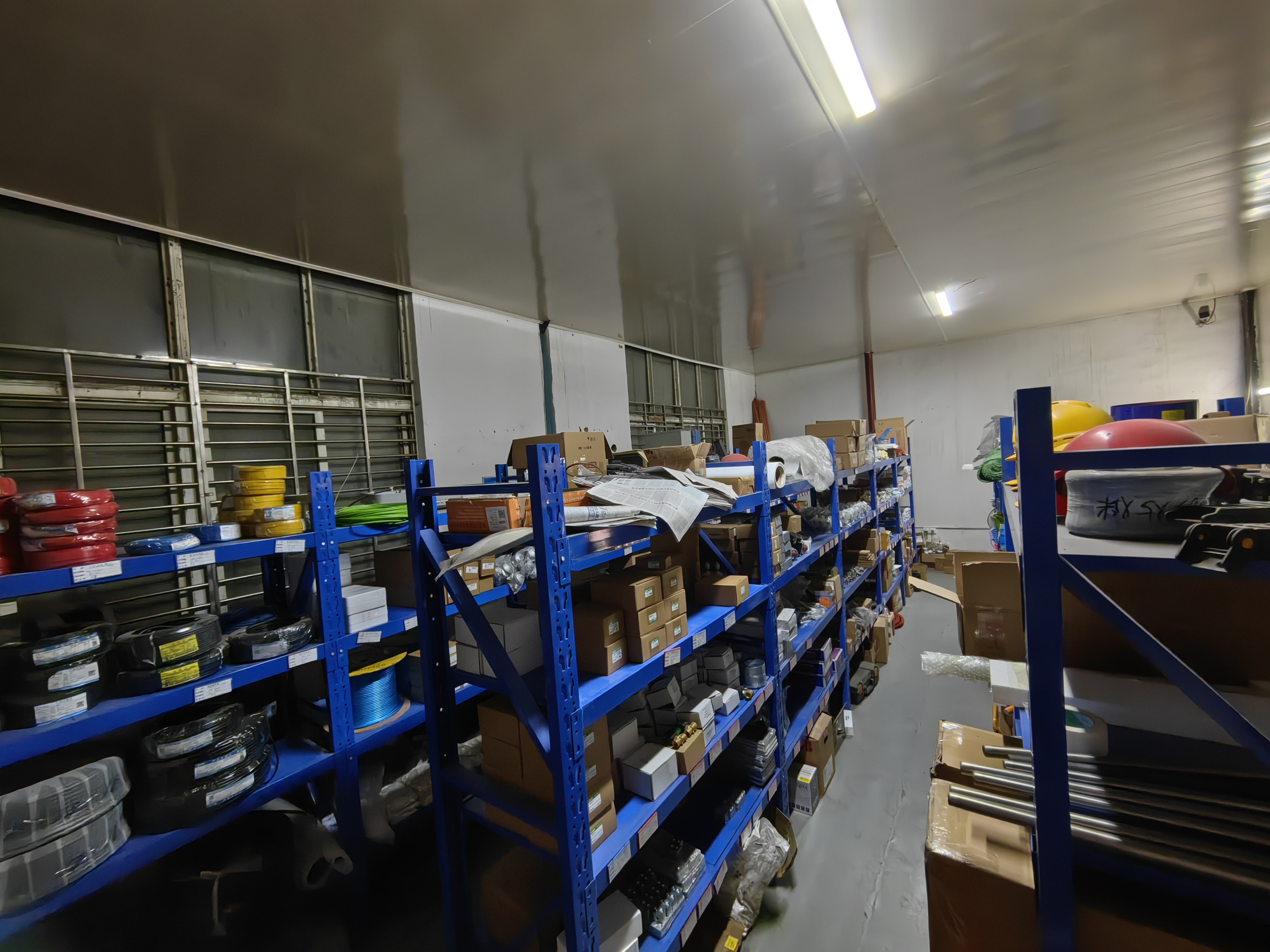
Spare parts holding and remote technical assistance close the loop after site acceptance.
Conclusion: file the certificate, then build the rest
ISO9001 does real work in a furnace procurement file — it tells you the supplier's system has been assessed within a stated scope, by a named body, between two known dates. What it cannot do is clear your market, satisfy your customer's qualification standard, or prove that the machine on your floor meets the utilities you actually have. Those belong to three gates that you control: a defined pre-shipment test, a witnessed factory pre-acceptance, and an on-site final acceptance that repeats the agreed checks against measured site conditions.
Build the file in that order, put the 6.5 metre crane clearance and the utility list inside the record rather than in an email, and fix the Incoterm and payment milestones against the same gates. Then the compliance question stops being about a certificate and becomes about a document set you can present to an auditor, a bank or your own customer.
The full product and capability overview is available in the NORSEN company brochure (PDF), and company details are published at www.norsengroup.com.
Have Questions or Need More Details?
Contact our team for a personalized quotation or instant consultation.
Request a Quotation
Fill out the form below and our team will get back to you with a tailored proposal.
WhatsApp Direct Chat
Prefer to chat in real-time? Message us on WhatsApp for instant assistance & quick answers.
- Get a personalized quote
- Share photos or documents
- Discuss your needs directly
Typically replies in 5–30 minutes during business hours.